RecA, Recombinant (100µg)
Product#: FNK-01-001
$95.92
Availability:
Ships in 1-2 Weeks
RecA, Recombinant
Cat. No. FNK-01-001
Size 100 µg
Store -20℃ (long period, -70℃)
E.coli Purity >90% (SDS-PAGE)
Concentration 0.9mg/ml
Description
E. coli RecA protein is a very important enzyme for homologous recombination and recombinational repair. Its synthesis is induced by SOS response caused by DNA damage. RecA protein has multiple functions such as single stranded DNA dependent ATPase activity, DNA annealing activity, formation of D-loop and Holliday structure in homologous recombination reaction, and coprotease activities that promote self-cleavages of LexA repressor, lambda phage repressor and UmuD protein. RecA protein binds to single and double stranded DNA for nucleofilament formation. It carries out a central role in homologous recombination. Its homologs in eukaryotes are Rad51 protein and Dmcl protein (1).
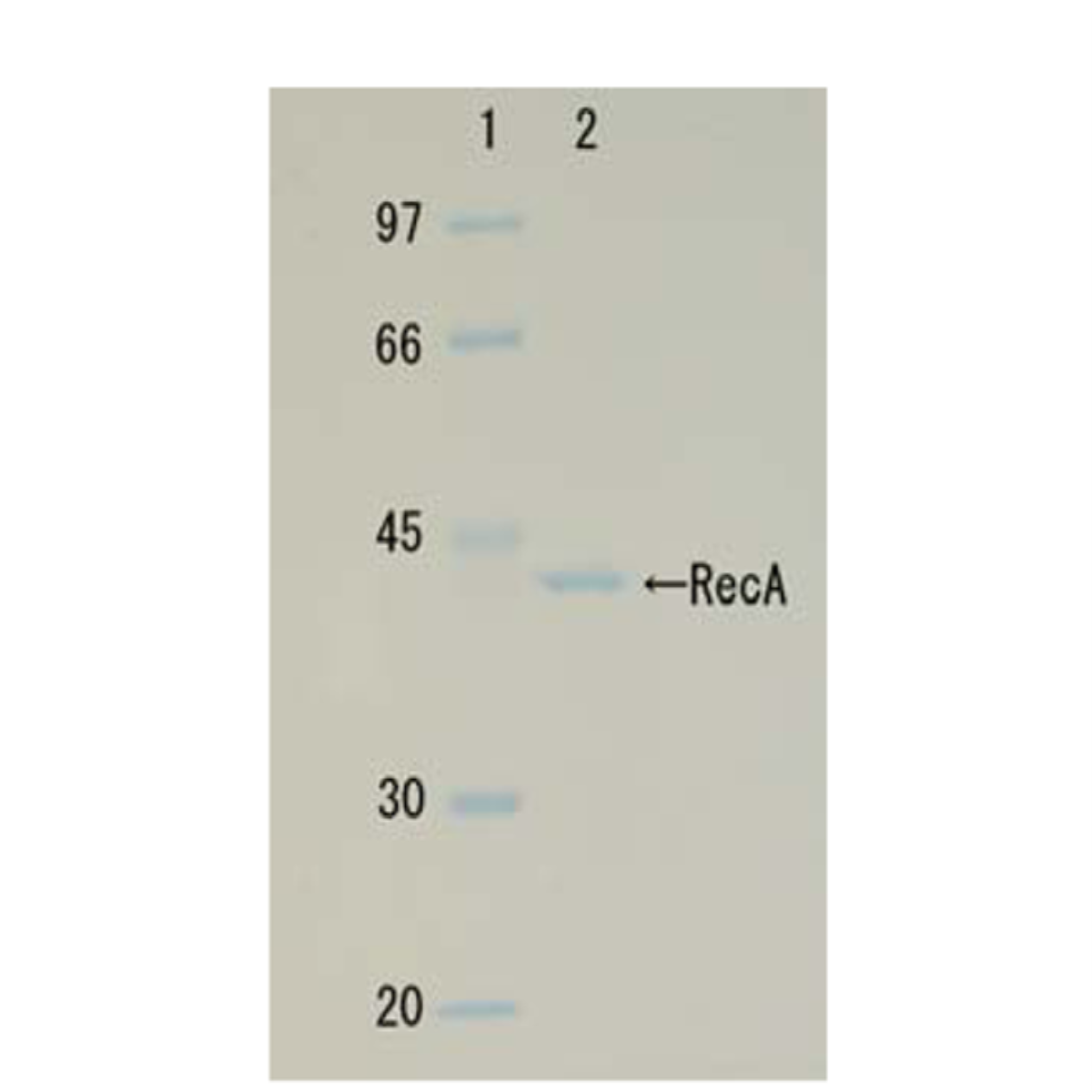
The product is over-expressed as a recombinant protein and highly purified by several steps of chromatography. A single band is observed by SDS-PAGE at 38 kD (Fig. 1).
The product is over-expressed as a recombinant protein and highly purified by several steps of chromatography. A single band is observed by SDS-PAGE at 38 kD (Fig. 1).
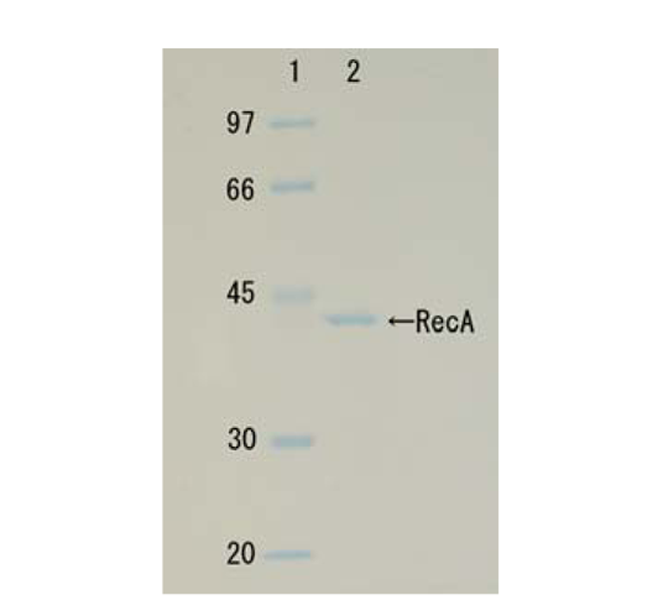
Fig.1 Polyacrylamide gel electrophoresis of RecA protein.
Applications
- Studies on homologous recombination mechanism and SOS response.
- Useful in the screening using probe from library by promotion of DNA hybridization (2).
- Facilitate DNA observation by electron microscope due to nucleofilament formation with DNA.
Purity Over 90% by SDS-PAGE (CBB staining)
Form 1.6 mg/ml in 20 mM Tris-HCl (pH 8.0), 1 mM EDTA, 150 mM KCl,7mM mercaptoethanol, 50% glycerol
Data Link UniProtKB/Swiss-Prot P0A7G6 (RECA_ECOLI)
Form 1.6 mg/ml in 20 mM Tris-HCl (pH 8.0), 1 mM EDTA, 150 mM KCl,7mM mercaptoethanol, 50% glycerol
Data Link UniProtKB/Swiss-Prot P0A7G6 (RECA_ECOLI)
References
- Waker GC “Understanding the complexity of an organism’s responses to DNA damage.” Cold Spring Harb Symp Quant Biol 65:1-10 (2000) PMID: 12760015
- Taidi-Laskowski B et al “Use of RecA protein to enrich for homologous genes in a genomic library.”Nucleic Acids Res 16:8157-8169 (1988) PMID: 2901713